
Artificial Intelligence has changed the world faster than anyone predicted. In just 20 years, AI moved from a niche academic topic to a technology that powers your phone, your doctor’s diagnosis, and the car you drive. This article walks you through that journey — where AI started, how it evolved, and where it stands today.
Table of Contents
Introduction: Why Artificial Intelligence (AI) Matters More Than Ever
Every industry today uses AI in some form. Banks use it to detect fraud. Hospitals use it to read scans. Retailers use it to predict what you will buy next. AI is no longer a futuristic concept — it is a present-day reality that shapes your daily life.
Understanding Artificial Intelligence helps you make better decisions — whether you are a business owner, a student, or simply a curious person. This guide breaks down the history, the evolution, the benefits, and the challenges of AI in plain language so you can follow along easily.
A Brief History of Artificial Intelligence
Artificial Intelligence did not appear overnight. Its roots go back to the 1950s, when mathematician Alan Turing asked a bold question: “Can machines think?” His famous Turing Test challenged researchers to build machines that behave like humans. That question lit the spark for everything that followed.
In 1956, scientists gathered at Dartmouth College and officially named the field “Artificial Intelligence.” Early researchers built programs that could solve math problems and play chess. These were exciting steps, but the hardware of the time could not keep up with the ambitions of the researchers.
Through the 1970s and 1980s, AI went through what experts call “AI winters” — periods where funding dried up because progress stalled. Rule-based systems were too rigid. They could only do exactly what programmers told them. They could not learn or adapt on their own.
By the 1990s, researchers shifted focus. Instead of writing rules by hand, they started teaching machines to learn from data. This shift — from rule-based AI to data-driven AI — changed everything and set the stage for the explosion that followed after 2003.
The Evolution of Artificial Intelligence: A Decade-by-Decade Breakdown
2003–2013: The Rise of Machine Learning
Between 2003 and 2013, machine learning took center stage. Researchers stopped programming AI with fixed rules and started feeding it massive amounts of data. The AI would then find patterns on its own. This was a game-changer.
Two big forces made this possible. First, the internet generated enormous volumes of data — text, images, clicks, and searches. Second, graphics processing units (GPUs) provided the computing power to crunch that data quickly. Together, these forces gave AI the fuel it needed to grow.
During this era, companies like Google and Amazon started using machine learning to improve search results and product recommendations. Email spam filters became smarter. Voice recognition systems started understanding what users said more accurately. AI was entering everyday life quietly but steadily.
2013–2018: Deep Learning Transforms Everything
Between 2013 and 2018, deep learning changed the game completely. Deep learning uses neural networks — layers of algorithms that process information the way the human brain does. These networks learned to recognize images, translate languages, and understand speech with stunning accuracy.
In healthcare, deep learning algorithms began analyzing X-rays and MRI scans. They detected tumors that human eyes sometimes missed. In transportation, companies like Tesla and Waymo used deep learning to teach cars to see the road and make real-time decisions. In entertainment, Netflix and Spotify used these models to recommend content that users actually wanted to watch and hear.
This period also saw AI enter creative fields. AI started writing news summaries, composing basic music, and generating simple graphics. Researchers realized that deep learning could handle far more complex tasks than anyone had imagined just a decade earlier.
2018–Present: Generative AI and the Intelligence Explosion
From 2018 onward, AI entered a new era. Researchers developed large language models (LLMs) — AI systems trained on billions of words from the internet. These models could write essays, answer questions, generate code, and hold realistic conversations. OpenAI’s ChatGPT, Google’s Gemini, and Anthropic’s Claude became household names.
Generative AI took the world by storm. Tools like DALL-E, Midjourney, and Stable Diffusion created photorealistic images from text descriptions in seconds. AI video generators produced short films from written prompts. Businesses started using AI to automate customer service, write marketing copy, and analyze financial reports.
This rapid growth also raised serious questions. Who is responsible when AI makes a mistake? How do we stop AI from spreading misinformation? How do we protect people’s data? Governments and researchers started working on AI regulations and ethical guidelines. The conversation around responsible AI became just as important as the technology itself.
How Artificial Intelligence (AI) Is Transforming Every Industry
Healthcare
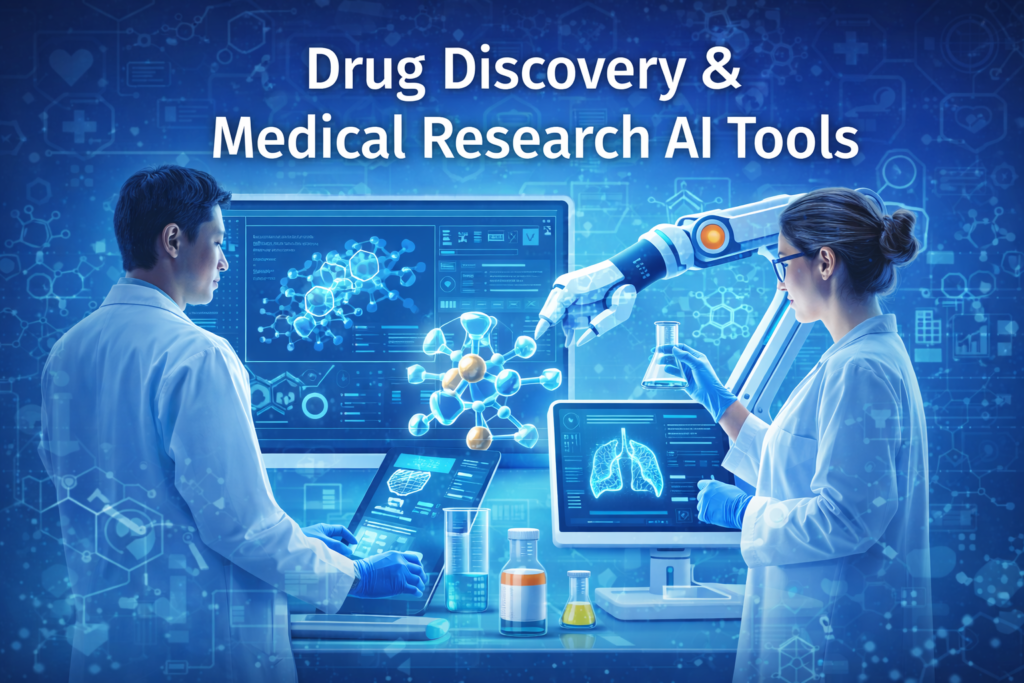
AI helps doctors detect diseases earlier and more accurately. Machine learning models analyze patient data to predict health risks before symptoms appear. AI-powered robots assist surgeons during complex procedures. Drug discovery, which used to take over a decade, now moves faster because AI models can simulate how molecules interact in the body.
Finance
Banks use AI to detect fraudulent transactions in real time. Investment firms deploy AI models to analyze market trends and execute trades at lightning speed. Credit scoring systems use AI to assess loan eligibility more fairly and accurately. Customer service chatbots handle millions of banking queries every day without human agents.
Education
AI-powered platforms create personalized learning experiences for students. If a student struggles with algebra, the system adjusts the difficulty and provides extra practice. Teachers use AI tools to grade assignments and identify students who need additional support. Language learning apps like Duolingo use AI to adapt lessons to each learner’s pace.
Retail and E-Commerce
Online retailers use AI to recommend products based on your browsing and purchase history. AI manages inventory by predicting which products will sell and when to restock. Visual search tools let shoppers upload photos and find similar items instantly. Chatbots handle customer service around the clock.
Manufacturing
Factories use AI-powered robots to assemble products with precision. Predictive maintenance systems analyze machine data and alert engineers before a breakdown occurs. AI quality control systems spot defects on production lines faster than human inspectors. These improvements reduce waste and increase output.
Transportation
Self-driving vehicles use AI to navigate roads, avoid obstacles, and make split-second decisions. Logistics companies use AI to optimize delivery routes and reduce fuel consumption. Airlines use AI to manage flight schedules, predict delays, and improve safety. Ride-hailing apps like Uber use AI to match drivers and riders efficiently.
Agriculture
AI-powered drones scan fields and detect crop diseases early. Smart irrigation systems use AI to water plants only when needed, saving water. Farmers use AI tools to predict weather patterns and plan harvests more effectively. AI helps feed a growing global population by making farming smarter and more efficient.
Key Features of Artificial Intelligence (AI) Today
Modern AI systems share several powerful characteristics that make them so useful across industries.
- Machine Learning: AI systems learn from data without being explicitly programmed for every scenario. They improve their performance the more data they process.
- Natural Language Processing (NLP): AI understands and generates human language. This powers chatbots, voice assistants, and translation tools.
- Computer Vision: AI sees and interprets images and video. It powers facial recognition, medical imaging, and self-driving cars.
- Predictive Analytics: AI analyzes historical data to forecast future outcomes — from stock prices to patient health risks.
- Automation: AI handles repetitive tasks without human intervention, freeing people to focus on creative and strategic work.
- Generative Capabilities: Modern AI creates original content — text, images, audio, and video — from simple prompts.
- Real-Time Decision Making: AI processes data and makes decisions in milliseconds, enabling applications like fraud detection and autonomous driving.
Real-World Use Cases of Artificial Intelligence (AI)
AI is not just a theory. Here are real examples of how it works in practice today.
- ChatGPT and Claude: These AI assistants answer questions, write code, draft emails, and solve problems in seconds.
- Google Search: AI ranks billions of web pages and delivers the most relevant results to your query in under a second.
- Spotify Discover Weekly: AI analyzes your listening habits and builds a personalized playlist every week.
- Tesla Autopilot: AI monitors the road, adjusts speed, and keeps the car in its lane using real-time sensor data.
- IBM Watson Health: AI assists oncologists by analyzing patient records and recommending treatment options based on clinical data.
- Amazon Alexa: AI understands voice commands and controls smart home devices, answers questions, and manages shopping lists.
- Grammarly: AI checks grammar, suggests better word choices, and improves writing style in real time.
- DeepMind AlphaFold: AI predicted the structure of over 200 million proteins, a breakthrough that accelerates drug discovery worldwide.
Benefits of Artificial Intelligence
Artificial Intelligence delivers real, measurable benefits to businesses and individuals alike. Here is what it does well.
- Boosts Efficiency: AI completes tasks faster than humans and works 24/7 without breaks. Businesses save time and cut costs.
- Improves Accuracy: AI reduces human error in data-heavy tasks like medical diagnosis, financial analysis, and quality control.
- Personalizes Experiences: AI tailors content, products, and services to individual users, improving satisfaction and engagement.
- Speeds Up Innovation: Researchers use AI to analyze data faster, accelerating discoveries in medicine, climate science, and engineering.
- Enhances Safety: AI monitors critical systems — power grids, aircraft, medical equipment — and alerts operators before failures occur.
- Scales Easily: One AI model can serve millions of users simultaneously, making it far more scalable than human teams.
Limitations of Artificial Intelligence
AI is powerful, but it has real weaknesses that users and businesses must understand.
- Bias in Data: AI learns from data. If that data contains biases — racial, gender, or socioeconomic — the AI will reproduce and even amplify those biases in its decisions.
- Lack of Common Sense: AI can process vast amounts of data but it does not truly understand context the way humans do. It can produce confident but wrong answers.
- High Costs: Building and training large AI models requires enormous computing resources, energy, and specialized talent — all of which are expensive.
- Privacy Risks: AI systems collect and process huge amounts of personal data. If mishandled, this data can be misused or exposed in security breaches.
- Job Displacement: Automation powered by AI threatens to eliminate certain jobs, particularly those involving repetitive or rule-based tasks. Workers in these roles need to reskill.
- Explainability Gap: Many advanced AI models work like black boxes. Users cannot always understand why the AI made a specific decision, which creates challenges in regulated fields like healthcare and law.
- Dependence on Data Quality: AI performs poorly when it trains on incomplete, inaccurate, or outdated data. Garbage in equals garbage out.
Conclusion
The last 20 years of Artificial Intelligence (AI) represent one of the most dramatic technological shifts in human history. AI moved from academic labs to your smartphone, your hospital, your car, and your workplace. It solves problems that once took years in a matter of seconds. It helps doctors save lives, helps farmers grow more food, and helps businesses serve customers better.
But AI also brings challenges. Bias, privacy risks, and job displacement are real concerns that demand careful attention. The goal is not to slow AI down — it is to guide it responsibly. With the right policies, ethical frameworks, and human oversight, AI can continue to improve lives without creating new injustices.
The next 20 years of AI will likely bring changes even more profound than the last 20. The decisions we make today — about how we build, regulate, and deploy AI — will shape that future. Now is the time to understand it, engage with it, and help steer it in the right direction.
Frequently Asked Questions (FAQs)
1. What is Artificial Intelligence in simple terms?
Artificial Intelligence is the ability of a computer or machine to perform tasks that normally require human intelligence. These tasks include understanding language, recognizing images, making decisions, and learning from experience. AI systems use data and algorithms to improve their performance over time without being reprogrammed manually for every new situation.
2. How has Artificial Intelligence changed in the last 20 years?
AI has shifted from rigid, rule-based systems to flexible, data-driven models that learn and adapt. Early AI could only follow fixed instructions. Today, AI understands human language, generates creative content, drives cars, and diagnoses diseases. The rise of machine learning, deep learning, and generative AI has made this transformation possible — driven by more data, faster computers, and smarter algorithms.
3. Which industries benefit the most from Artificial Intelligence?
Healthcare, finance, retail, manufacturing, transportation, and agriculture all benefit enormously from AI. In healthcare, AI detects diseases earlier. In finance, it prevents fraud. In retail, it personalizes shopping. In manufacturing, it reduces downtime. In transportation, it powers self-driving vehicles. In agriculture, it improves crop yields. Almost every industry that handles large amounts of data stands to gain from AI adoption.
4. What are the biggest risks of AI?
The biggest risks of AI include algorithmic bias, data privacy violations, job displacement, and the spread of misinformation through generated content. AI can also fail unpredictably when it encounters situations outside its training data. In high-stakes fields like medicine and law, a wrong AI decision can cause serious harm. Addressing these risks requires strong regulations, transparent AI design, and ongoing human oversight.
5. Will AI replace human jobs?
AI will automate many repetitive and routine tasks, which means some jobs will disappear. However, AI also creates new jobs — in AI development, data science, ethics, and model oversight. History shows that every major technology wave destroys some jobs and creates new ones. The key is adaptation. Workers who learn to use AI tools and develop skills that AI cannot replicate — such as creativity, empathy, and complex judgment — will remain in demand.
6. What is generative AI and why does it matter?
Generative AI is a type of artificial intelligence that creates new content — text, images, audio, video, and code — based on patterns it learned from training data. Tools like ChatGPT, DALL-E, and Claude use generative AI. It matters because it dramatically lowers the cost and time needed to create content, write software, and solve complex problems. Businesses use it to automate marketing, customer support, and product design. Individuals use it to learn faster, write better, and build things they previously lacked the skills to create.
Related Articles on AI
Best AI Tools List 2026 – Top Artificial Intelligence Software
Ultimate Guide to the Best AI Speech-to-Text & Voice Tools in 2025
Top AI Video Tools That Make Images and Videos Easy
Ultimate Guide to AI Writing and Productivity Tools for Content Creators
